
For those of you who show in the NRCHA boxing class and/or the Box Drive class, the scorecard in 2026 is going to look a bit different. The Judge’s committee improved the scorecard to make it easier for the judges to separate works more effectively while accurately documenting what happened in the run. All of the definitions below are for both classes but there are now 7 run content boxes for the boxing scorecard. I will use Bill Enk’s (the NRCHA Director of Judges) explanations, as no one could say it any better.
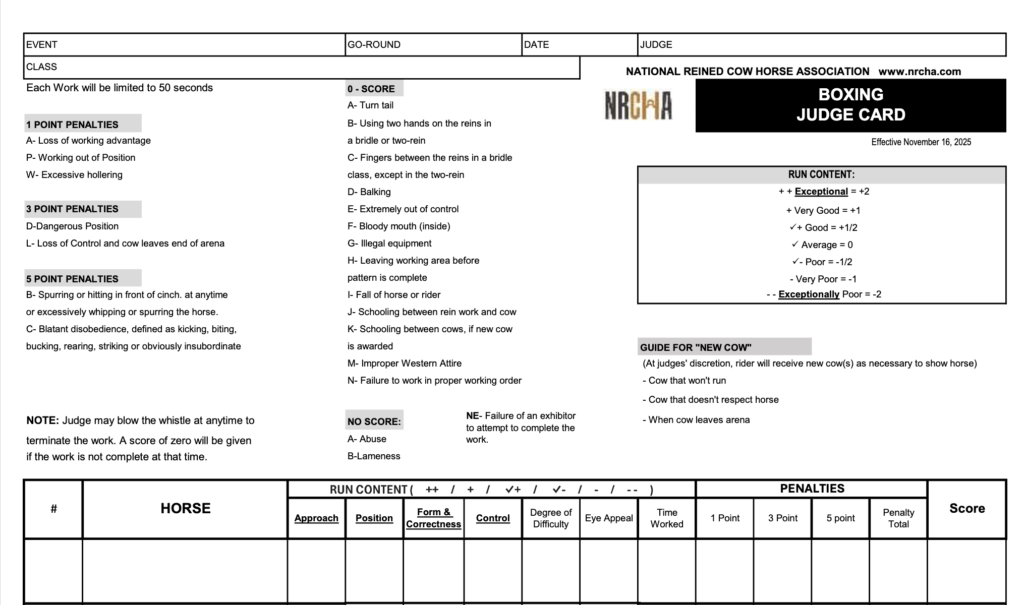
- Approach. Is the exhibitor in the proper position to have immediate influence on the cow when it enters the arena? Does the rider read the cow properly when stepping up to the animal? Is it a smooth, calculated approach?
- Position. Does the exhibitor find and stay in a position to control the animal throughout the work? If the exhibitor is in and out of position throughout the work, what’s the fair mark for the position box? If it is not all poor, nor, all good, the score should reflect this and be somewhere in the middle.
- From and Correctness. Boxing the animal correctly should show rate, stop and turn, in that order. Exhibiting correctness and good form is the most effective way to work and control a cow. Doing a fence-type turn in the boxing class is not a positive due to the usual rolling up on the cow during the turn. This type of turn makes the exhibitor progressively late during the exit.
- Control. Control is the ultimate objective when attempting to work a cow. Being able to control an animal that exhibits some degree of difficulty in the middle half of the arena demonstrates control and should be viewed positively.
- Degree of Difficulty. The degree of difficulty must come from the animal itself, not from the exhibitor who’s out of or losing position causing the animal to run. It’s important to recognize the difference and score accordingly. Positive scores come from exhibitors who can control a cow that exhibits a degree of difficulty.
- Eye Appeal. This is the one strictly opinion box on the scorecard. Judges can use this box to advantage when attempting to place and separate horses. Excessively pinned ears or tail switching could be negatives, whereas a horse that’s enthusiastic and acts like he likes his job could be a positive. It’s all in the eyes of the beholder.
- Time Worked. This is basically an exhibitor time-management box. How much of the 50 seconds does the exhibitor actually work the cow? It starts from the time the animal enters the arena. How long does it take to assume working position? Is the time spent working the cow quality time, or is it just spent standing or chasing the animal back and forth? The “Courage” box was replaced with “Time Worked.” This change was based on some exhibitors’ incorrect interpretation of courage. Continuous activity without setting up the cow and working it with form and correctness doesn’t demonstrate courage in the boxing class.
Buster Welch, a cutting horse legend, summed it up this way: “Don’t mistake activity for achievement.” Form and correctness, along with control and time worked, are all keys to credit-earning runs. Even with a lesser degree, these three ingredients beat speed with little or no form and correctness.
For more info visit NRCHA.com to familiarize yourself with the 2026 scorecards. The definitions go for the box-drive class as well.
Here’ a wonderful video of Tule Dowers showing us what a great boxing run looks like:
2025 SBF_TULI DOWERS-NP BOXING_H264-M-P on Vimeo
Food and Cmax Overview
Food and Cmax Overview
amoxicillin rare side effects
amoxicillin rare side effects
augmentin vs amoxicillin for otitis
augmentin vs amoxicillin for otitis
vardenafil food interactions overview
vardenafil food interactions overview
vardenafil 20 mg dose notes
vardenafil 20 mg dose notes
avanafil medical use limitations
avanafil medical use limitations
xenical prezzo amazon
xenical prezzo amazon
cenforce 200 mg reviews
cenforce 200 mg reviews
vidalista 40 mg tadalafil
vidalista 40 mg tadalafil
vidalista black reviews
vidalista black reviews
doryx cost
doryx cost
lasix furosemide price
lasix furosemide price
doryx for sinus infection
doryx for sinus infection
zoloft for anxiety
zoloft for anxiety
What a great summary of the presentation yesterday! Thank you so much! I loved the emphasis on position and control. That’s gonna help me and my students!
Great information. Thank you. Makes me excited to see how my horse and I do next year under the new scoring!